
A new woodworking installation adorns one of the hallways at the Conestoga Skilled Trades Campus. Created as a collaboration between first-year Bachelor of Interior Design students and graduating Woodworking Technology students, the feature wall celebrates Conestoga successes at Skills Ontario.
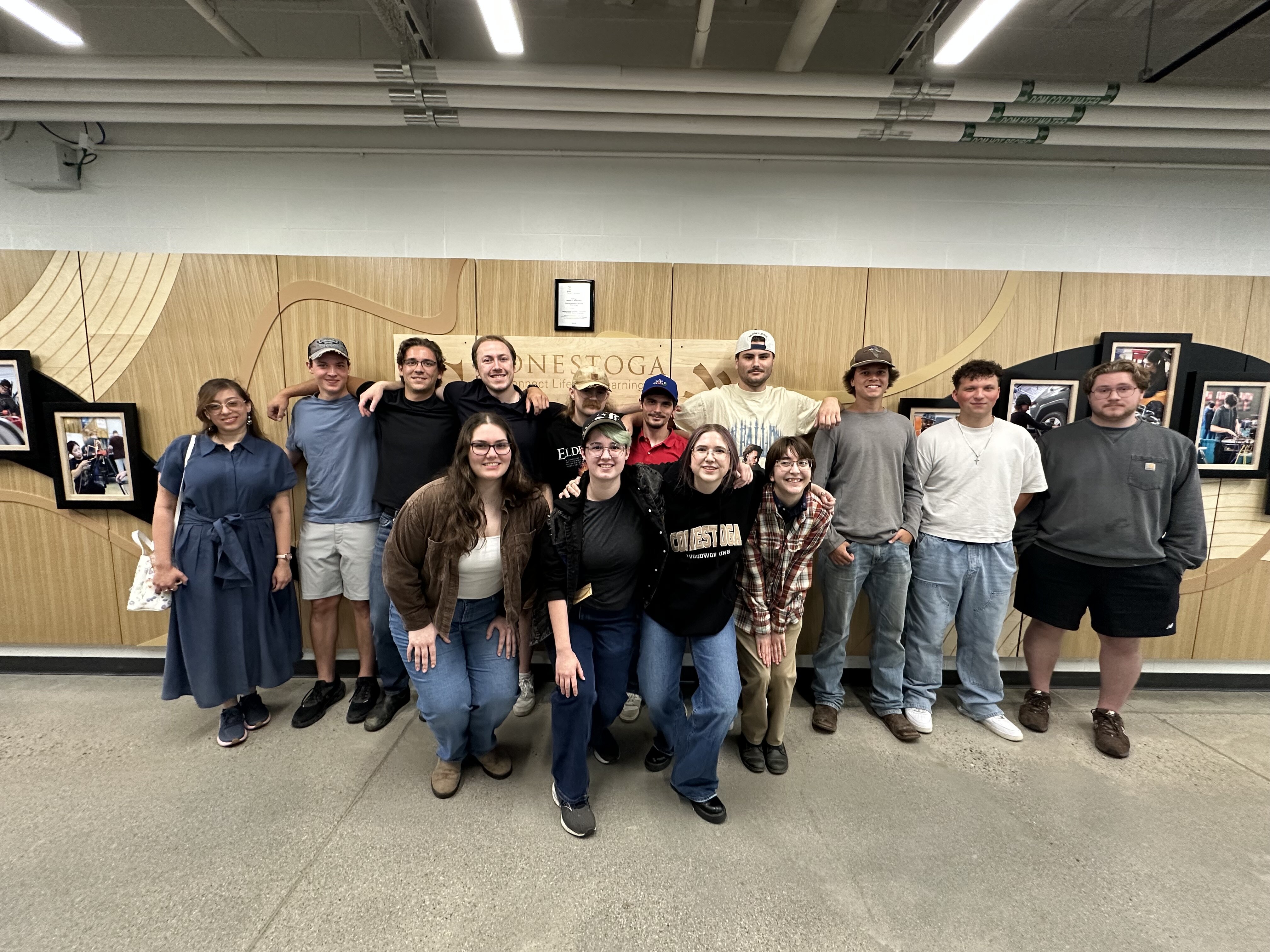
The newest feature wall at the Conestoga Skilled Trades Campus celebrates Conestoga successes at Skills Ontario.
Skills Ontario is the largest skilled trades and technology contest in Canada and offers an opportunity for Ontario elementary, secondary and post-secondary students and apprentices to demonstrate and test their skills. In 2026, Conestoga students finished the competition with 15 medals. The college was also named the recipient of the College Award of Distinction, granted to the institution with the highest overall competitor achievement at the Skills Ontario Competition.
The project started as an assignment for Bachelor of Interior Design students during the fall 2025 term, in which they were tasked with developing a design to highlight the college’s involvement in the provincial competition. At the end of term, groups pitched their ideas to the chair of the School of Engineering & Technology, and Steve Bader, Woodworking program coordinator and professor. “Considering the number of students we had available to work on this as well as how much time we would have in the shop, we decided which idea was the most doable,” explained Bader.
The idea that was chosen was designed by Bianca Lima De Barros, Ava Amerkashi, Justin Nebrasca and Andrea Fernanda Prado Erazo. It consists of white oak veneer panels, ten maple picture frames and fibreboard accents.
Ring details appear along the picture frames, which are connected through black fibreboard. “We were inspired by the idea of a growing tree and path. The rings symbolize growth, and the path represents going through life,” said Amerkashi. Fibreboard ribbons in bronze, silver and gold shades represent the medals won at the skills competition.
Woodworking students constructed the design as part of their capstone project. They spent the winter term engineering it, then manufactured throughout the spring term. In total, the 18 students spent over 55 hours in the shop.
This is the second installation at the campus at 25 Reuter Drive in Cambridge. The first went up in 2025 to celebrate the college’s Women in Skilled Trades (WIST) initiative.
“This is an awesome integration of different programs, and a great work-integrated learning situation. When working in the industry, it’s normal for woodworkers to be given work from designers, and they have to figure out how to make it a reality while still satisfying the designer,” said Bader.
Conestoga’s Bachelor of Interior Design program provides students with the theoretical, practical and technical skills that reflect the interior design profession. Through a comprehensive curriculum delivered by an interdisciplinary faculty, the program prepares students to apply an integrated approach to interior design solutions for the built environment and its occupants and meet the demands of technological changes and currency with respect to sustainability, universal design and health and safety.
The Woodworking Technology three-year advanced diploma program provides students with theoretical and practical training related to the technology and skills involved in the efficient and quality-conscious manufacture of furniture, cabinets and architectural millwork. Through co-op, students are provided the opportunity to relate in-school training with real industrial experience.